
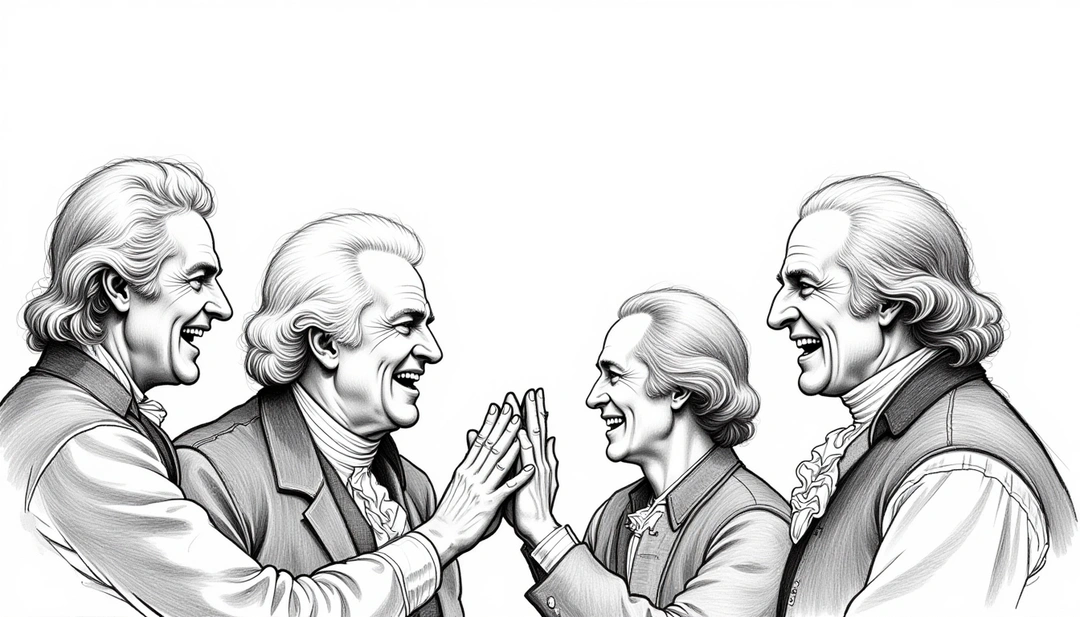
Understand Our Founding Fathers
A New Way of Seeing the World
The Enlightenment was a powerful movement in the 17th and 18th centuries that transformed how people thought about God, nature and what it means to be human. It crossed the Atlantic into the American colonies and deeply shaped the minds of the Founding Fathers. These men did not see themselves as preserving old traditions; they saw themselves as building a new world on the foundation of reason, evidence and clear thinking.
The Founders and the Age of Reason
In this age, reason was not just a personal virtue; it was the central tool for understanding everything from the motions of the planets to the purposes of government. Enlightenment thinkers believed that by using reason, human beings could uncover truths about the universe and improve their own condition here on earth. The Founding Fathers absorbed these ideas. When they debated laws and drafted documents, they treated reason as a guide that could lead to better institutions, fairer rules and a more just society.
You can see this spirit in the Declaration of Independence. The famous claim that “all men are created equal” and are endowed with “unalienable Rights” such as “Life, Liberty and the pursuit of Happiness” is not meant as a poetic flourish. It is a clear statement that human beings possess rights by their very nature and that legitimate government must recognize and protect those rights. For the Founders, these truths were “self-evident” not only because they were obvious to everyone, but because they also followed from a careful, reasoned view of human nature and justice.
Reason, Rights and Human Purpose
Enlightenment thought held that the goals of rational humanity were knowledge, freedom and happiness. The Founders echoed this belief. Knowledge meant more than information; it meant understanding the world well enough to act wisely. Freedom meant more than escape from a king; it meant having space to think, speak, worship and work according to conscience. Happiness meant more than pleasure; it meant the flourishing that comes from living a life consistent with one’s nature and purpose.
When the Founders wrote about “liberty,” “self-evident truths,” and “happiness,” they used these words with rich and layered meanings drawn from their time. “Liberty” included both the freedom to act and the responsibility not to violate the rights of others. “Self-evident” referred to truths that could be grasped by a well-trained reason considering human nature and moral law. “Happiness” pointed toward a life of virtue, fulfillment and well-being, not merely momentary enjoyment.
Words with Fuller Meanings
Modern dictionaries often give shorter, thinner definitions than those familiar to the generation of the Founders. To get closer to how they understood key terms, it is helpful to consult early American sources such as Noah Webster’s 1828 dictionary. This resource was created close in time to the founding era and reflects many of the nuances they heard in words like “right,” “liberty,” and “happiness.” Examining these older definitions can reveal how much depth the Founders packed into phrases that may now seem simple.
Because of this, it is fair to say that the Founders meant exactly what they said—and more than many readers hear today. Their language rests on a worldview in which human beings are rational, moral creatures, endowed with rights, capable of self-government and called to seek a well-ordered happiness. When we read their words with that context in mind, the founding documents become not just historic artifacts, but living invitations to think more deeply about reason, freedom and what it means to live well.
Dave Kluge
www.understandtheconstitution.com
Author of The People’s Guide to the United States Constitution. The book presents the original texts of the Declaration of Independence, Constitution, Bill of Rights and all amendments, with enough background, examples, and definitions to easily understand and read straight through these documents.